

2026 Business Leaders Priorities: AI Helps Offset Challenges to Growth
- Lectura de 6 minutos
- Last Updated: 12/01/2025

Table of Contents
Businesses want to grow in 2026, with almost two-thirds — 63% — across all business sizes listing it as a top priority.
Our seventh annual Business Leaders Priorities survey, conducted online in partnership with independent research firm Bredin, found this response nearly unanimous from 750 Business Development Managers and HR Development Managers at companies across the United States with five to 1,000 employees.1 All business segments placed it either first or second on the priority list, with four naming it a clear-cut No. 1.
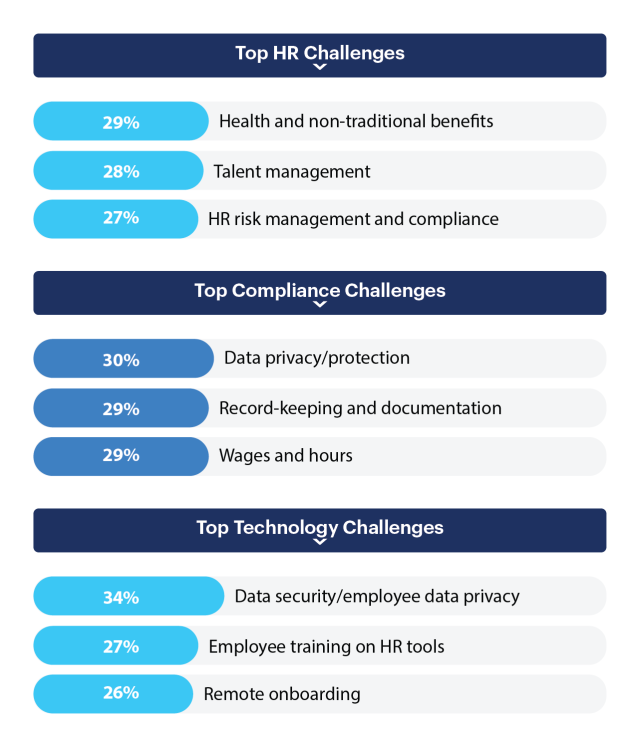
While leaders seek to outsource HR administration tasks through the leverage of technology, HR tools, and expert HR advice to help with their main business priorities, some challenges stand in the way. Paychex took a closer look in this report.
What Is Hindering Business Growth?
In the current economic environment, the main obstacles standing in the way of growth are all related to money.
Rising Costs/Inflation
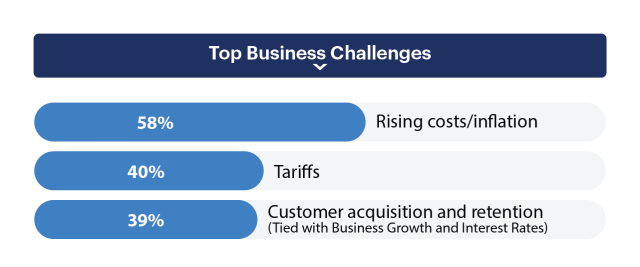
The combination of rising costs and inflation is the runaway consensus for the top business challenge at 58%, with all five segments naming it first as extremely or very challenging. Also impacting finances are the second-most extremely or very significant challenge: tariffs.
Now, this challenge could be alleviated with the case before the U.S. Supreme Court that questions the legality of some of the current tariffs placed on countries around the world. There are also product-specific tariffs on everything from lumber and auto parts to aluminum and agricultural goods that impact everything from farms to major automobile manufacturers.
Growth vs. Growth
Interestingly, business leaders said their top priority faces itself as one of the biggest challenges. Alison Stevens, Senior Director of HR Solutions at Paychex, said her team is hearing that more.
“Many of our clients have plans to expand in the new year, however, we’re also hearing about challenges in sourcing qualified candidates, particularly specialized or even part-time roles,” Stevens said. “One client we work with is in a high-growth mode, but they are challenged by a number of things, including acquiring employees and trying to have them adopt new standards. They are spending money to recruit but running into issues during onboarding because of the candidates themselves.”
As Stevens explained, the business needed people to fill positions and fuel growth, but candidates might have oversold their qualifications on resumes and interviews. Then, during onboarding, they walked away because they lacked specific skills. So, the employer is left with a big cost output for recruitment and training yet gained nothing from it. They now need to repeat the process to add employees.
“These challenges are not just operational; they represent strategic risks to our clients’ ability to scale effectively,” she said.
Automating Processes
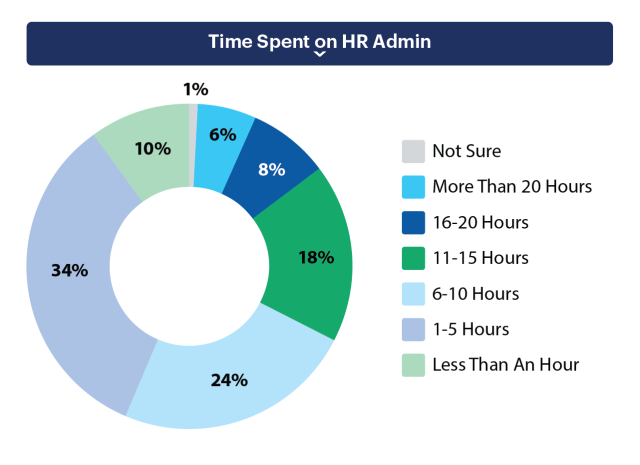
With 34% of businesses in the survey spending one to five hours while another 24% logging six to 10 hours weekly on HR administration — this includes 17% of the time on payroll processing and 13% on people management — AI-powered automation can make a difference for any size business.
Five business sizes ranked payroll processing in the top three, while four of five placed people management in the top three of the tasks requiring a good portion of their time to perform.
However, technology selection (34%), AI adoption/usage (33%), and cybersecurity (38%) often keep businesses standing pat with their time-consuming and often costly processes. The total spend for all HR tasks is estimated at $175,684 per year, with payroll ($29,768) and people management ($22,382) outpacing all other tasks by the next-nearest extremely or very significant challenge (tracking employee hours) by an estimate of $13,500 and $6,000, respectively.
“Across our client base, there is a clear and growing interest in leveraging AI to drive operational efficiency, enhance decision-making, and improve employee experiences,” Stevens said. “Clients have been actively exploring AI applications around using AI to screen resumes, forecasting workforce trends, and turnover risk.”
Stevens also said that it was great to see how this momentum reflects a broader shift in mindset among small businesses.
“Clients are not viewing AI as a futuristic concept anymore. They are recognizing it as a strategic enabler of business transformation,” she said.
Cost of Automation
The basic tenet to growth is investment. Businesses must spend money. But even if a business is somehow managing with inflation and tariffs, they run into their next challenge. Interest rates (39%) are tied with customer acquisition and retention — another cost, and quite frankly, the lifeblood of business growth.
Interest rates impact funding access, and even though the Federal Reserve has recently lowered the federal funding rate several times, bank rates on loans haven’t dipped enough to encourage purchasing (e.g., equipment) and expansion. The impact of the government shutdown also hindered the Small Business Administration from granting access to the popular 7(a) loans and 504 loans. According to the SBA, this kept $170 million of government-backed funds from reaching businesses daily.
“(Paychex) tries to help businesses make informed decisions that save time and money,” Stevens said. “I talk to clients about the benefits of HR technology integration because many just want to deal with one vendor.”
One example of this is the accessibility of handbooks through technology platforms, which can save time and money. Businesses with this technology would no longer need to direct their energies and money to an attorney to create their handbook.
Additional Costs of Adopting AI for Businesses
With its data lakes representing hundreds of thousands of aggregated client interactions, Paychex is seeing an uptick from businesses expressing concern that they suspect technical issues with job posting platforms and a growing urgency that hiring tools aren’t yielding results. This signals a need, among several, for better training on platform usage.
Training/Skill Improvement
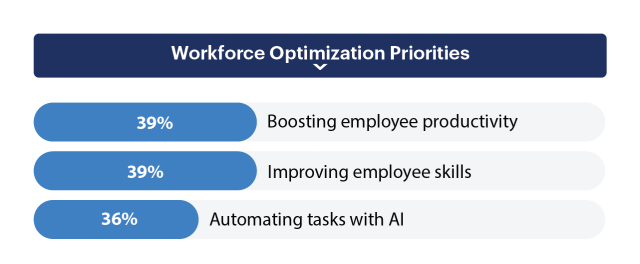
With an influx of more AI in every facet of work this could mean more training. Improving skills, including training with AI, tied for the top response among workforce optimization priorities at 39%.
“There’s a clear and growing demand for training programs that help HR teams, managers, and employees understand, adopt, and leverage AI effectively,” Stevens said. “This includes how to make data-informed decisions, how to use AI tools for workforce planning and employee engagement, and educating employees on the importance of proper AI use.”
Getting employees up to speed on training, and specifically now with AI training, will cost money. It also might cost a company some of its employees.
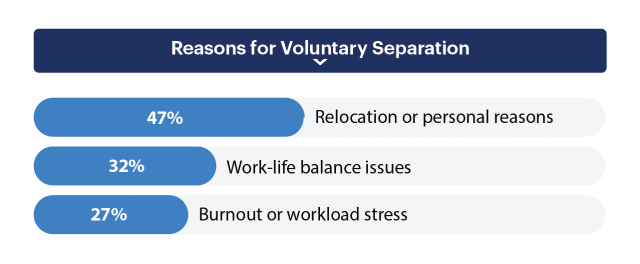
Upskilling an employee on AI is important. However, some employees might be working under the auspices that the AI they are training on might eventually replace their role. There is also the potential for burnout, especially if businesses use AI to get lean. One of the top three reasons for voluntary separation, according to survey respondents, is burnout or workload stress (27%).
Turnover
More than half those surveyed (51%) said their company had experienced separation in the past two years, and although the reasons covered a wide range, burnout was a third choice for three of the business segments. In fact, the bigger a business got, the higher the burnout percentage grew.
More than a third of respondents (37%) also said their business had seen involuntary separations (layoffs, terminations for cause) in the past two years, a majority based on attendance (51%) or performance issues (51%).
Turnover is a deterrent to growth because it puts businesses on a constant cycle of recruiting, onboarding, and training — each requiring significant investment. Losing an employee at any size business, on average, costs $12,531. Estimates from respondents in the largest businesses put that cost, depending on the position, at $200,000.
When growth is a top priority, the amounts associated with losing an employee can weigh heavy on HR personnel charged with getting recruiting, hiring, and retention right the first time. A few misses, especially at the largest businesses, could be financially prohibiting. At a small business, it could be the difference between keeping the doors open.
“We’re trying to solve supporting clients through best quality hiring decisions. Making sure they are trained. Making sure candidates get put through the right process,” Stevens said. “So, that means writing a good job description, brainstorming about getting after the right talent pool, training your group how to properly interview and select, evaluating your benefits.”
Paychex HR personnel recorded a 38% month-over-month increase from September to October from employers asking for strategic hiring support, including interview guidance, onboarding plans, and job description reviews. There also was an increase in requests for live training sessions focused specifically on hiring effectiveness and turnover reduction.
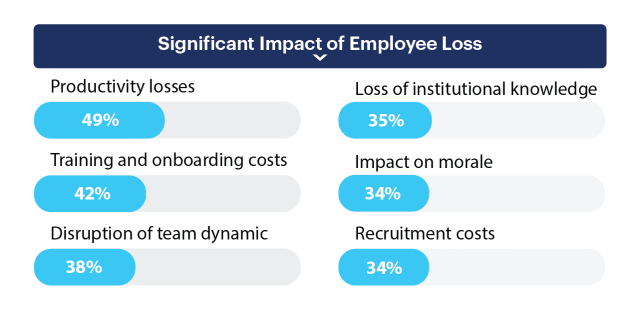
Why? All business sizes in this report named “training and onboarding costs” as the top or second-most extremely or very significant challenge of losing an employee. There are other losses associated with an involuntary or voluntary separation with an employee, and not all related to money, with businesses citing impacts on team dynamics and employee morale among the top five.
“There is a lot going on in our workforces. Our clients’ employees are increasingly vocal about their expectations — and the message is clear: They want more than just a paycheck,” Stevens said. “They are seeking structured growth opportunities to include digital fluency and AI literacy, they seek work-life balance as a baseline expectation, and they place a high value on open dialogue and authentic leadership that listens and acts.”
These trends reflect a workforce that is more empowered, more informed, and more elective — a shift that presents challenges and opportunity.
“Employers need to invest in that strategy of the employee experience and make it a good one, or they will be in a never-ending cycle of turnover and not being able to compete,” Stevens said.
Using AI To Benefit Your Business
In a different survey conducted by Bredin, different size businesses use AI for different purposes.2
- Businesses with 1-19 employees use it for web analytics and business intelligence
- Businesses with 20-99 employees automate workflows and strengthen cybersecurity
- Businesses with 100-1,000 employees use virtual assistants and upgrade customer service
So, the general pattern that emerged is the smallest businesses use artificial intelligence to get better quality and stronger sales; businesses with 20-99 employees gain sales growth and customer insights; the larger companies (100-1,000 employees) lean on AI for better data security and faster growth. As businesses grow, they tend to move from analysis to automation to transformation.

1 The 2026 Paychex Business Leader Priorities Report surveyed 750 business development managers and HR development managers at companies across the U.S. with 5 to 1,000 employees from Sept. 1-19, 2025.
2 Survey conducted from June 2-18, 2025, of businesses with 1 to 1,000 employees.
Paychex Can Help Your Business Succeed
Investing in and adopting AI for everyday processes? Discover how Paychex AI Solutions and a Paychex HR solution can help improve efficiency and support your business needs.
Paychex can’t change inflation or tariffs, but we provide best-in-class tools, expertise, and human interaction that help remove the barriers to growth.
Tags