

45 Payroll Industry Statistics on Growth, Pay, and Trust
- Lectura de 6 minutos
- Last Updated: 10/26/2026

Table of Contents
Many businesses, especially small businesses, aren't sure how to navigate payroll accurately without dedicated, certified staff.
Two main forces are currently shaping the payroll industry: continued growth in outsourcing and payroll technology, and evolving employee demand for pay transparency and self-service tools. Paychex's 2026 Employee Compensation Confidence Index, an anonymous, public survey of 1,034 full-time U.S. employees conducted online by independent research firm Centiment, shows that only 22% of employees are very confident their pay is accurate, competitive, and keeps up with the cost of living, and 43% experienced a paycheck error in the past year. For many, the mistake cost real money: 42% of those workers paid out of pocket, through overdraft charges, late fees, or similar costs, and 57% of them paid $100 or more.1
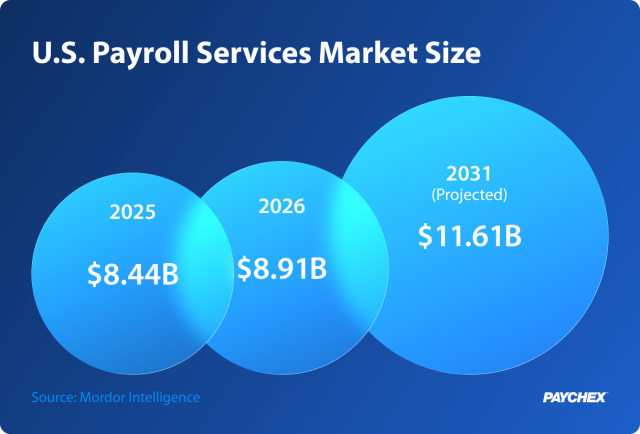
Those findings come as the U.S. payroll services market continues to grow steadily, from $8.91 billion in 2026 to a projected $11.61 billion by 2031.2 Below, we've gathered 45 payroll industry statistics, combining our new survey data with Paychex's Small Business Employment Watch and third-party research. They cover market size, paycheck confidence, pay gaps, cost-of-living pressure, payroll errors, and the tools employees say would help.
Employers and HR professionals need up-to-date small business payroll statistics to compare their own practices. We'll explore our own data on the payroll industry, alongside industry-level growth data, to provide context for payroll in 2027.
The Payroll Industry by the Numbers
According to the latest payroll industry statistics, the payroll field is growing steadily and is estimated to be worth over $11 billion by 2031.2 We're seeing many companies move beyond AI hype to find ways artificial intelligence can make payroll work more accurately and efficiently.
- Small business workers earn $34.50 per hour on average as of August 2026. Wages have grown 2.89%, or 97 cents, YOY on average.4
- Workers in the Midwest and Northeast have seen slightly higher wage growth than the rest of the country. But workers in the West still have the highest earnings: $36.56 on average per hour.4
- Job growth fell 0.70 percentage points YOY in August 2026. It's been largely flat since the start of 2024, though it's slowed somewhat this year.5
- The U.S. payroll market size is currently valued at $8.91 billion and is estimated to grow 5% a year, reaching $11.61 billion by 2031.2
- Small businesses account for 47% of the U.S. payroll service market share and are projected to grow 11% per year through 2031, the fastest growth of any company size.2
- Healthcare is 21% of the nation's payroll services market by end user. The IT sector is expected to pick up speed, though, and grow 10% a year through 2031, faster than any other industry.2
- 93% of U.S. workers receive their pay through direct deposit. The second-most popular option is paper paychecks, though that's only used by 3% of workers.3
- The average yearly salary for a compensation analyst ranges from $61,750 to $85,750, depending on location and experience. Compensation ranges from $79,500 to $115,000 for compensation managers.6
- Salaries for compensation and benefits professionals are up 2.4% YOY, driven by regulatory complexity and expanded role responsibilities.6
How Confident Employees Are in Their Own Paychecks
Fewer than one in four employees are fully confident that their pay is accurate, fair, and keeps up with the cost of living all at once, according to payroll statistics in our Employee Compensation Confidence Index.1 Employees tend to be confident that their pay is accurate. But relatively few feel secure that their wages are keeping up with the rising cost of living nationwide.
- Only 22% of employees are very confident that their paycheck is calculated correctly, competitive, and keeps up with the cost of living.1
- Only 45% of employees are very confident that their pay is competitive, and 34% are very confident their pay keeps up with the cost of living.1
- 29% of workers aren't confident or are only somewhat confident that their paycheck is calculated correctly every pay period.1
- In a separate survey, 61% of employees said they are certain that, specifically, the payroll withholding and net amount of their paycheck are correct each payday.3
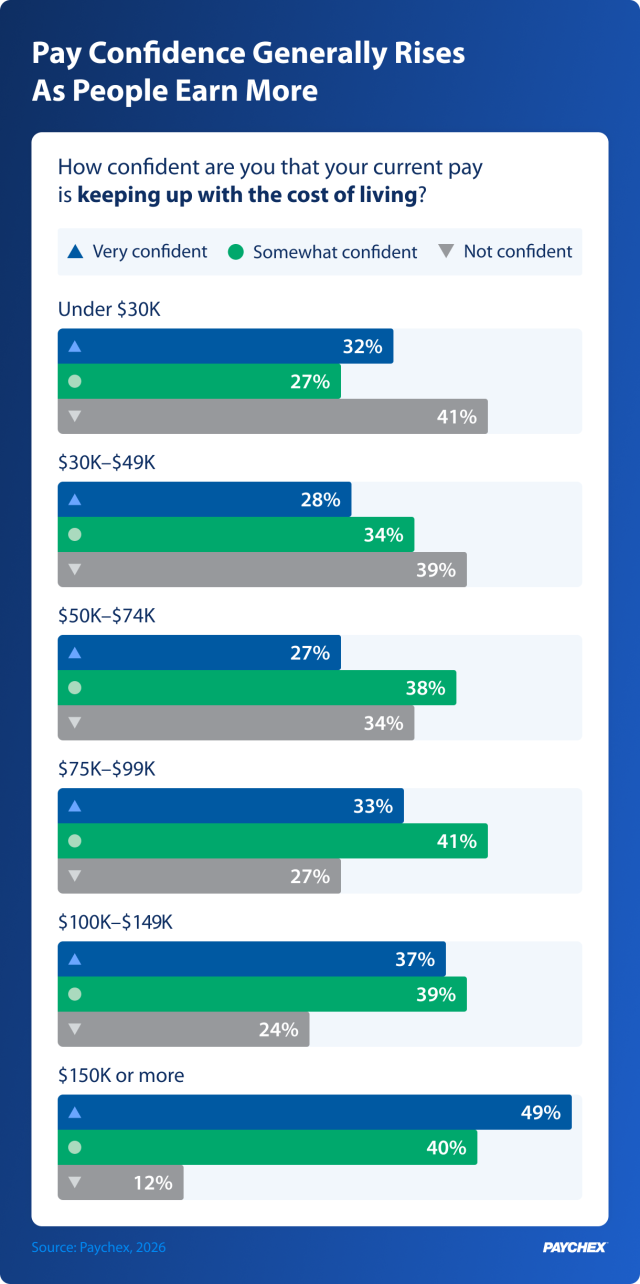
- 41% of employees making under $30,000 a year aren't at all confident that their pay keeps up with costs, compared with 12% of those making $150,000 or more.1
- 86% of workers say their employer offers a self-service portal, where employees can access their pay and benefits information online.3
- 69% of hourly workers are very confident their pay is calculated correctly, compared with 77% of salaried workers.1
The Gender Pay Gap in Payroll Data
Women's pay doesn't always reflect how vital they are to the workforce. Gender pay gap statistics show women still make less than their male colleagues, on average. This disparity is even wider for women of color, disabled women, and LGBTQ+ women.
- Only 38% of women are very confident their pay is competitive for their role and experience, compared with 51% of men.1
- Women are less likely than men to feel very confident that their current pay is keeping up with the cost of living (29% of women vs. 38% of men). Women are also less likely to say their pay has increased enough in the last year to keep up with rising prices (29% of women vs. 37% of men).1
- Women working full-time, year-round, are paid only 76 cents for every dollar paid to men. This difference is starker for some women of color: Black women only earn 65 cents for every dollar earned by a white, non-Hispanic man. Hispanic and Indigenous women just earn 58 cents.7
- Women working full-time will lose nearly $550,000 to the gender pay gap over the course of their careers.8
- 38% of company leaders say their organizations are embedding diversity and inclusion in their talent systems, including sourcing, hiring, and promotions. 39% are prioritizing pay equity in their diversity and inclusion strategies.9
Pay and the Rising Cost of Living
According to Paychex's Employee Compensation Confidence Index, 62% of employees say their pay has not fully kept up with rising prices over the past year.1Groceries may cost less than the typical rent or mortgage payment, but they're the top cost pressure for people right now, not housing.
- 31% named groceries as their top cost pressure, ahead of housing or rent at 18%.1
- 29% of workers currently have at least one extra job to help cover their cost of living.1
- Consumer prices rose 3.4% between August 2025 and August 2026. Wages rose only 3.1% in that same period. 10, 11
- 67% of U.S. consumers live paycheck to paycheck. 43% live paycheck to paycheck, but don't have issues paying bills, and 24% struggle to pay bills.12
- 20% of workers say their employer does not offer annual pay raises. 12% don't know if their employer offers them.3
- 78% of workers who get raises say their annual pay raise is not enoughto keep up with inflation.3
Payroll Mistakes and Their Cost to Employees
Payroll administrators are human, so payroll mistakes happen. But those mistakes can have serious consequences for the company and its employees if left uncorrected.
- 43% of workers have experienced a paycheck error in the past year.1
- Among workers who have had a paycheck error, 42% paid out of pocket after their last incorrect paycheck, such as an overdraft or a late fee.1
- Of employees who paid out of pocket due to a paycheck error, 57% paid $100 or more.1
- 45% of workers who paid out of pocket delayed buying necessities like groceries, gas, or even medicine after a paycheck error.1
- 42% of workers are only somewhat confident or aren't at all confident that, if they noticed a mistake on their paycheck today, it would be fixed quickly.1
- 50% of workers say it would be "very difficult" to meet their current obligations if their next paycheck were delayed for a week. Only 21% say it would be not very difficult or not at all difficult.3
- 33% of hourly workers had two or more paycheck mistakes in the past year, vs. 24% of salaried workers.1
- 31% of hourly workers say how often they’re paid affects their money stress a lot, compared to 24% of hourly workers.1
Pay, Retention, and Workforce Trends
It's common for employees to leave a job due to pay concerns if their problems are never resolved. Employee retention statistics show workplaces are still struggling to find the balance between fair pay and business needs.
- 47% of employees have seriously considered leaving a job because of a pay problem, and 19% have actually walked away from one.1
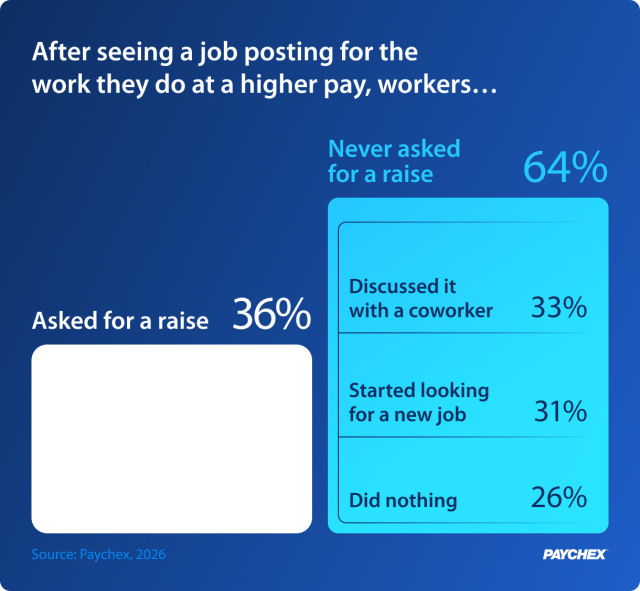
- 55% of workers have seen a job posting for the same work they do at a higher pay rate. But 64% never asked for a raise afterward, and 31% started job hunting instead.1
- 15% of all workers and 19% of HR professionals say employee stress and burnout are among the most important issues for their organizations to address.13
- 72% of workers say their organization could do more to meet their needs. 65% say they believe their organization is actively working to address their needs, though. 13
- As of May 2026, 52% of U.S. employees are watching for a new job or actively seeking one. But only 28% believe now is a good time to find a job.15
- Pay and benefits are the most common reasons people leave their jobs. 16% said it was the primary reason they left their previous job, a higher percentage than career opportunities, work-life balance, or lack of respect.15
The Payroll Tools Employees Say They Want
Paychex data show that paycheck previews may significantly improve employees' confidence in the accuracy of their pay. Services like Paychex Pre-Check® can show employees their paycheck in advance, so they can catch mistakes before they hit their bank account.
- 48% of employees say previewing their paychecks before payday would build trust, more than any other option offered, such as early access to their earned pay (40%), automatic error alerts (36%), plain-language breakdowns (24%).1
- 47% of employees would utilize, or already utilize, early access to earned pay if it were offered by their work. 1
- 30% of employees feel comfortable with AI being used to calculate their pay. While some feel uncomfortable about the idea (34%), more people feel neutral (36%).3
- 45% of employees feel uncomfortable with AI tools answering their payroll questions instead of a person. 28% feel neutral about AI tools being used this way, and 27% feel comfortable.3

1 Paychex (2026). Employee Compensation Confidence Index.
2 Mordor Intelligence (2026). United States Payroll Services Market Size & Share Analysis.
3 PayrollOrg (2025). 2025 "Getting Paid in America" Survey.
4 Paychex (2026). Small Business Wage Data.
5 Paychex (2026). Small Business Jobs Index.
6 Robert Half (2026). Human Resources Salaries and Salary Trends.
7 National Women's Law Center (2026). A Window Into the Wage Gap.
8 AAUW (2026). The Simple Truth About the Gender Pay Gap.
9 McKinsey & Company (2026). The State of Organizations 2026.
10 U.S. Bureau of Labor Statistics (2026). Consumer Price Index for All Urban Consumers: All Items in U.S. City Average.
11 U.S. Bureau of Labor Statistics (2026). Average Hourly Earnings of All Employees, Total Private.
12 PYMNTS (2026). The Fragmented Paycheck: Why Rising Spending No Longer Means Stronger Demand.
13 Society for Human Resource Management (2026). 2026 State of the Workplace: Insights to Shape the Future of Work.
14 Gallup (2026). State of the Global Workplace 2026.
15 Gallup (2026). Employee Retention & Attraction.
Build a Payroll Employees Can Trust
The payroll industry will continue to grow and adopt new solutions to meet the needs of growing businesses. But it's challenging to gain employee trust if you're a small business without your own payroll staff.
Paychex Flex® is the next best thing to an in-house payroll team, offering payroll, benefits, compliance, and HR for even the smallest teams. It also offers additional tools, such as garnishment payment services and general ledger services, for larger companies that need more support.
Tags