

62% of Employees Say Their Pay Hasn't Fully Kept Up With Rising Costs
- Lectura de 6 minutos
- Last Updated: 10/26/2026

Table of Contents
62% of U.S. employees say their pay has only partly kept up with rising costs over the past year, or has fallen behind entirely, according to Paychex’s 2026 Employee Compensation Confidence Index, an anonymous, public survey of 1,034 full-time U.S. employees conducted by independent research firm Centiment.
For many, one job isn't enough. 29% currently work at least one extra job to make ends meet. And pay problems have pushed people out the door: 47% have seriously considered leaving a job over a problem with their pay, and 19% actually did.
Full confidence is rare. Only 22% of employees are very confident that their pay is accurate, fair for their role, and keeps up with the cost of living, all at once.
Here's what's behind workers' feelings about their pay, and what would help earn their confidence.
Three Pay Factors Determine the Employee Compensation Confidence Index Score
We judged employee confidence on three main pillars: Do employees feel their pay is accurate, that it's competitive and fair, and that it keeps up with rising costs? While the majority (71%) of employees feel very confident that their paycheck was calculated correctly, fewer feel very confident in their pay itself. 45% feel very confident their pay is fair, and 34% feel very confident their pay keeps up with the rising cost of living.
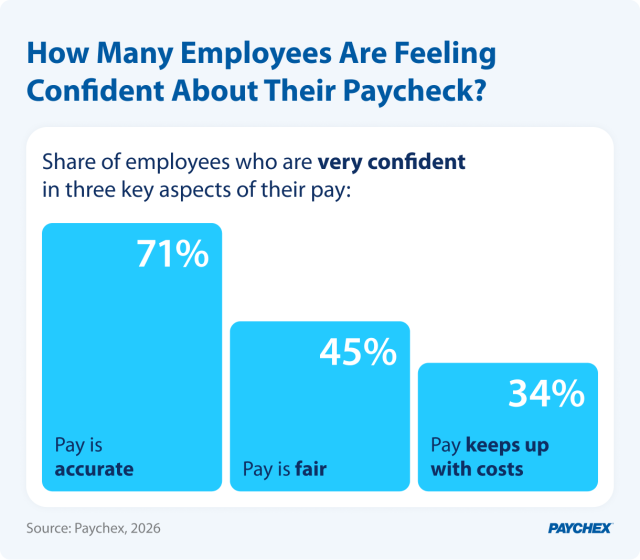
Some employees may think their pay is accurate or fair, but relatively few believe it's simultaneously accurate, fair, and keeps up with costs. Only 22% say they're very confident in all three aspects of their pay.
That score isn't spread evenly across the workforce. Men are far more likely than women to be fully confident in their pay (26% vs. 17%). Seniority makes an even bigger difference: only 12% of employees who don't manage anyone hit full confidence, compared with 40% of VPs and C-suite executives.
Income matters, too. 32% of employees earning $150,000 or more are fully confident, nearly double the 17% of those earning under $30,000. And the cost-of-living pillar is where lower earners struggle most. 41% of employees making under $30,000 a year aren't at all confident their pay keeps up with costs, compared with 12% of those making $150,000 or more.
The gap between pay that's accurate and pay that's enough is something HR teams hear about directly.
"Employees want confidence that they are being paid accurately and fairly," says Lisa Reyes, HR Services Area Manager at Paychex. "As costs continue to rise, many employees are also looking for reassurance that their pay supports their financial well-being and long-term goals."
31% of Employees Say Rising Grocery Prices Have Put the Most Pressure on Their Paycheck This Year
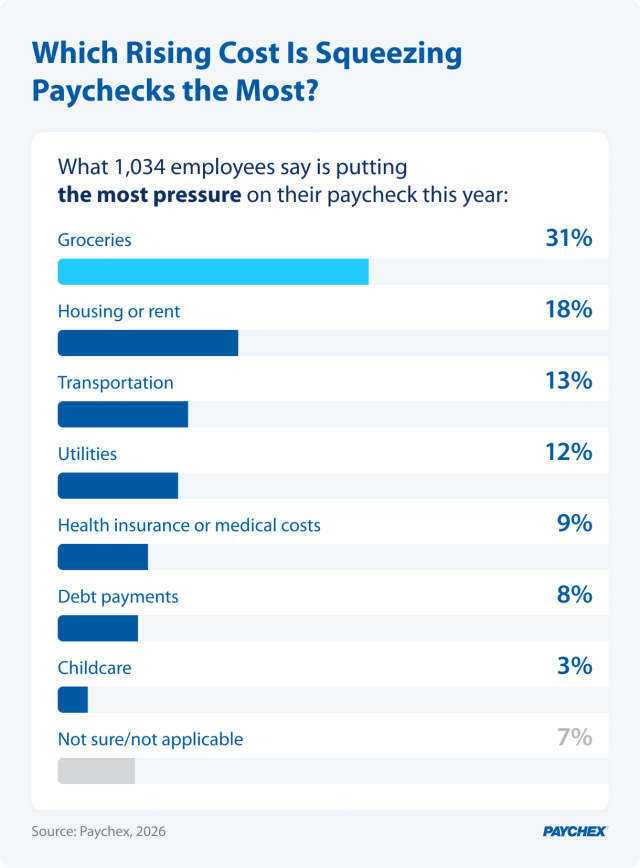
Workers' most common problem with their paycheck is the compensation itself. 62% of employees say their pay has only partly kept up with rising prices or has fallen behind entirely over the past year. Grocery prices create the biggest squeeze: 31% say groceries are their top cost pressure, ahead of housing or rent (18%).
Data from the U.S. Bureau of Labor Statistics (BLS) and Paychex support workers' concerns. Between September 2025 and September 2026, overall prices rose by 3.7%. Meanwhile, hourly earnings have only risen 2.78% between September 2025 and September 2026, according to Paychex data from customers with fewer than 50 employees. Modest price increases are normal and even healthy for the economy. But wages need to grow year over year, too, so workers can keep food on the table.
29% of employees currently work at least one extra job to help cover the gap between their earnings and the cost of living. So for some, this financial squeeze eats into both their money and the time they could have spent recharging for the next day at work.
Pay schedules matter, too. 69% of employees say how often they're paid affects their money stress, and weekly-paid employees were the most likely to say it affects them 'a lot' (35% vs. 25% of those paid every two weeks).
It’s hourly workers who feel that pay pressure the most. 31% say how often they’re paid affects their money stress a lot, compared with 24% of salaried employees. They’re also less sure their pay is right in the first place: 69% are very confident their paycheck is calculated correctly (vs. 77% of salaried workers), and 34% have been paid for the wrong number of hours at some point (vs. 22%).
For employees whose bills don’t line up with payday, earned wage access (EWA) can ease some of that pressure. EWA lets workers withdraw money they’ve already earned before their regular payday. Since June 2024, nearly 119,000 employees have used it through Paychex.
43% of Employees Had a Paycheck Mistake in the Past Year, and Some Paid for It
If it's not in the budget, individual employers may not have the wiggle room to adjust staff pay, but they can adjust their payroll processes to ensure paychecks are error-free. That's important, given that 43% of respondents experienced a paycheck error in the past year. And for many, it wasn't a one-time slip. 63% of them dealt with two or more.
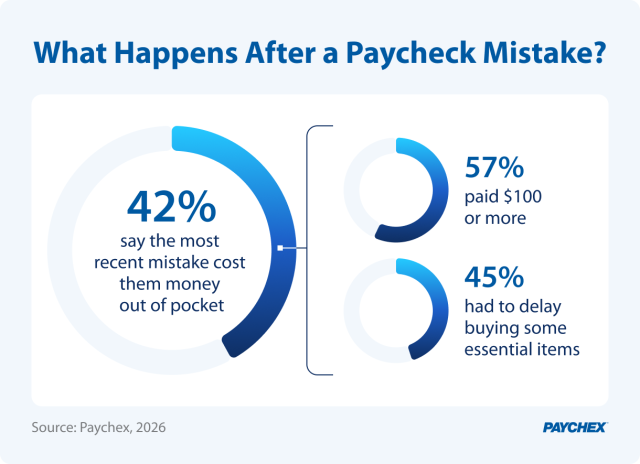
Paycheck errors, such as miscalculated deductions or incorrect hours, can also continue to affect workers even after the problem has been addressed. 42% of employees who experienced a paycheck error incurred out-of-pocket costs, such as overdraft or late fees.
These fees often stack up if someone can't catch them in time. Of employees who paid out of pocket, 57% paid $100 or more, and additional fees caused 45% of that group to delay buying necessities like groceries, gas, or even medicine.
Most employees who encounter a discrepancy catch it themselves: 57% found the error, while only 13% heard about it from a coworker or manager. Another 22% didn't find out until their bank account flagged a problem or a bill didn't go through.
That lines up with what HR teams see day-to-day. Reyes says employee questions often center on understanding payroll deductions and changes in take-home pay, which are exactly the kinds of details workers end up double-checking.
If you're a business owner, you'll want to catch payroll errors before employees do. Paychex can help with that WISE, the AI engine built into PaychexFlex®, offers AI-powered payroll insights and suggested actions in real time, helping busy payroll teams catch discrepancies before they cause issues. WISE Intelligence's proactive payroll management enabled nearly 90% of identified time and pay rate errors to be corrected before payroll run day.
47% of Employees Have Thought About Quitting Over a Pay Problem
Whether a paycheck itself is incorrect or your staff is unhappy with their salary, pay issues can have significant effects if left unresolved. 47% of employees have seriously considered leaving a job because of problems with their pay, and 19% have actually walked away from one.
This is especially true for Gen Z workers: 59% of employees ages 18 to 29 have considered leaving over pay, compared with 23% of those 62 and older.
Adjusting employee compensation plans or providing annual cost-of-living raises can help align salaries with workers' expectations. But lack of communication about pay can be a blocker: 55% of workers have seen the same work they do posted at a higher payrate, either at their own employer or another company, but 64% of those who saw such a posting never asked for a raise afterward. Some of that group started job hunting instead (31%).
Reyes says employees also want to know "whether compensation reflects their contributions and the market value of their role." That's where communication makes the difference.
"Trust starts with transparency," she says. "Employers that proactively communicate consistently and with proper notice on how compensation decisions are made, what influences pay increases (parameters and guidelines), and how employees can grow and earn more within the organization create a stronger sense of fairness and confidence."
Employees who are already stretched thin are the least likely to speak up. Of those who've seen a higher-paying posting, only 21% who aren't at all confident their pay keeps up with the cost of living asked for a raise. That's less than half the rate of those who are very confident (46%). They were just as likely to start job hunting, though (35% vs. 34%). That makes pay a retention issue as much as a payroll one, and it's easier to address if you open the conversation before employees start looking elsewhere.
48% of Employees Say a Paycheck Preview Would Build Trust. The Tool Already Exists.
There are a few options available to HR and payroll teams that want to strengthen trust with staff. 48% of employees say that accessing a preview of their paycheck before payday would build their trust, the most of any option we asked about. Early access to earned pay came in second (39%), followed closely by automatic error alerts (36%). When asked to pick just one fix, 26% still chose a paycheck preview, ahead of early access (21%) and error alerts (17%).
And interest in early pay isn't theoretical: 47% of employees say they would use early pay or already do.
A preview shows employees what's on their paycheck. Clear communication about how pay is set shows them why.
"When employees understand the 'why' behind pay decisions and feel their contributions are recognized, they are much more likely to trust their employer and remain engaged," Reyes says.
How Employers Can Rebuild Trust in the Paycheck
Employees want to trust that their paycheck will arrive on time and that the numbers on it will all be correct. But that trust has to be earned, and most of what earns it is within an employer's control. A few places to start: explain how pay decisions get made, check pay against the market, make pay stubs easier to understand, and let employees preview their pay.
Pay preview tools are often built into software that businesses already have, so it's just a matter of turning them on Paychex Pre-Check® makes proactive communication between employers and staff easy. With Pre-Check, employees can preview their pay stubs before payroll is processed, so they can identify and flag payroll discrepancies early and feel confident that their final pay is accurate.
Methodology
The survey was conducted online by Centiment, with a total sample size of 1,034 full-time employed U.S. adults aged 18 and older. To qualify, each respondent had to be currently employed by an employer (not self-employed or a business owner) and receive a regular paycheck.
Fieldwork was undertaken from August 21 to August 31, 2026. Results are weighted to match the U.S. census. The margin of error is approximately ±3% for the overall sample at a 95% confidence level.
The Employee Compensation Confidence Index Score is calculated as the percentage of employees who answered "very confident" on all three of the survey's core pay questions: whether their pay is calculated correctly, whether it's fair for their role, and whether it's enough to cover the cost of living.

Tags