

5 Technologies Every Growing Restaurant Should Consider
- 6 min. Read
- Last Updated: 09/14/2026


Table of Contents
Restaurant margins are thinner than they look on paper. Full-service labor costs are on the rise and food costs remain well above pre-pandemic levels. In this environment, restaurants must seek out which tools actually protect their bottom line.
Growing restaurants don't need to adopt every new system on the market at once. They need the right combination that fits how the business actually runs. Here are five categories worth evaluating, and how to think about each one through a margin-first lens.
Point of Sale (POS) System
A modern point of sale (POS) system works as the operational hub every other technology on this list connects to. Without a POS system restaurants must cautiously keep tabs over inventory and payments under multiple systems or manually.
Cloud-based, mobile POS platforms allow staff to take orders on tablets, and many now integrate with self-service kiosks so customers can order on their own. A strong system accepts contactless payment at the table, tracks inventory in real time, and flags low stock before it becomes a problem. Look for a POS that collects customer data, either through its own loyalty tools or by integrating with a CRM, so repeat guests and large orders can get noticed automatically.
Because payment, customer loyalty, and staffing data all run through it, the POS system is usually the first place to look when deciding where a technology upgrade will pay off fastest.
Mobile & Contactless Payment
The days of paying with cash and card are behind us. What once seemed to be an emerging trend is now standard infrastructure. Contactless and mobile payment are now the preferred method of paying by most consumers, and many expect to find it at the table, not just the counter.
A secure payment system should accept chip cards and digital wallets, integrate directly with the POS, and issue digital receipts automatically. Connecting payment data to loyalty and analytics tools turns every transaction into information the restaurant can use to spot its best customers and busiest hours.
However, processing fees are worth watching closely. Card processing now ranks as the third-largest operating expense for most restaurants, behind food and labor, and a majority of operators report their fees have risen in the past two years. A well-negotiated online payment processing setup helps keep that cost in check without asking customers to change how they pay.
Online Ordering & Delivery
Over the last decade, the popularity of online ordering has skyrocketed. This is due in part to the advancement of mobile phones and the post-pandemic world. Online ordering splits into two paths, first-party and third-party, and the difference matters for margins.
First-party ordering runs through a restaurant's own website, app, or QR code at the table. It keeps full control over the menu, pricing, and customer relationship, and it carries no commission fee. Third-party delivery companies extend reach and handle logistics, but they charge a commission on every order, which can quietly erode already thin margins.
Many growing restaurants use both: first-party ordering for regulars and repeat business and third-party for new-customer discovery, with the fee math tracked closely, so delivery growth doesn't outpace profit.
AI & Automation for Front and Back of House
AI now supports several everyday restaurant tasks, from forecasting demand to answering guest questions, without replacing the people who run the floor.
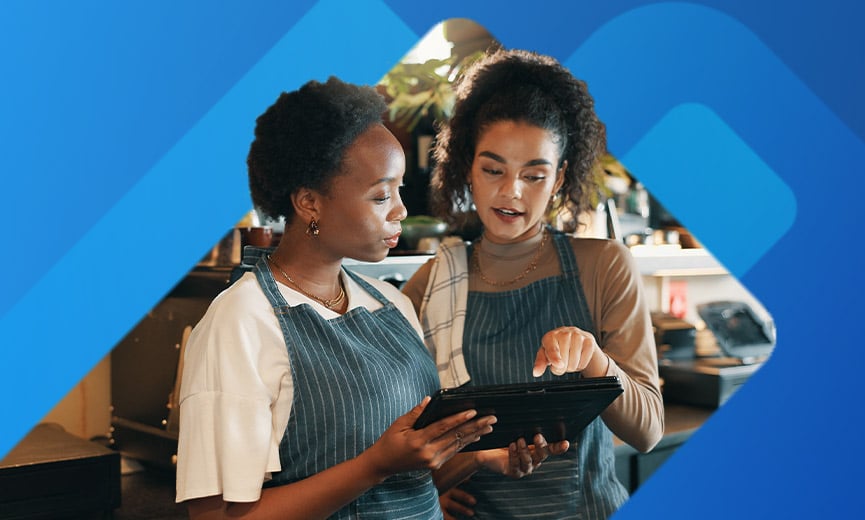
At the back of house, AI can forecast busy shifts and ingredient needs to reduce waste, and support scheduling by suggesting staffing levels based on expected demand. At the front of house, kiosks and voice ordering give guests another way to order at their own pace, while chatbots handle reservations, waitlist updates, and common questions so staff can focus on the dining room.
Adoption is still early industry-wide, with AI-related tools and marketing being the most common use case today. Restaurants that add AI in a targeted way, one task at a time, tend to see the clearest return. The goal is a tool that helps and supports staff, not one that replaces them.
Scheduling & Labor Management
Labor remains the single largest controllable cost in most restaurants, which makes scheduling software one of the highest return technology investments available.
Nearly all operators name labor as a top challenge and finding experienced cooks and managers continues to be difficult.1 Good scheduling software is fully mobile, letting employees check shifts, request swaps, and get alerts from anywhere.
Leading platforms also let managers message individuals or groups, track time, and help calculate wages and tips, all while integrating with payroll and the POS. Fast onboarding matters too, especially in an industry where turnover is high and new hires need to get up to speed quickly.
Pairing scheduling software with reliable time tracking gives owners a clearer, more accurate picture of labor cost as it happens, rather than after the pay period closes.
Restaurant Technology FAQs
-
How Is Technology Changing the Restaurant Industry?
How Is Technology Changing the Restaurant Industry?
Restaurants are moving from disconnected, paper-based processes to systems that share data across ordering, payment, and staffing. That shift lets owners see problems, like a slow shift or a rising food cost, in real time instead of after the fact, which is why technology adoption has become a bigger part of the industry's response to margin pressure.
-
What Technology Do Restaurants Use?
What Technology Do Restaurants Use?
Most restaurants run on a small set of connected systems rather than a single all-in-one platform: a POS system, payment processing, an online ordering setup, staff scheduling software, and increasingly, AI tools for tasks like forecasting or guest messaging. Which combination makes sense depends on the restaurant's size, service style, and where its margin pressure is greatest.
-
How Can Technology Improve Restaurant Margins?
How Can Technology Improve Restaurant Margins?
The right technology narrows the gap between what a restaurant plans for and what actually happens on a given shift. Accurate demand forecasting reduces food waste, better scheduling prevents overstaffing and understaffing, and first-party ordering keeps more of each sale rather than losing a share to commission fees.
-
How Do Restaurants Adopt New Technology Without Disrupting Operations?
How Do Restaurants Adopt New Technology Without Disrupting Operations?
A phased rollout works better than switching every system at once. Introducing one tool at a time, training staff during slower shifts, and choosing systems that integrate with the existing POS all help a restaurant adopt new technology without a full stop-and-restart of daily operations.
Choosing the Technology That Fits Your Restaurant
Growing restaurants don't need every technology on this list on day one. The stronger approach starts with whichever tool removes the most friction and protects margins right now, whether that's a POS upgrade, adding first-party ordering, or building out AI-assisted scheduling.
As labor and food costs continue to rise, having the right systems in place gives owners more room to focus on the guest experience instead of paperwork.
About the Author
Tags