

Form 1099-MISC Filing Guide for Small Business Owners
- 6 min. Read
- Last Updated: 10/30/2026

Table of Contents
Businesses that pay vendors, landlords, attorneys, and other nonemployees may need to report those payments to the IRS. Choosing the right form now requires businesses to look at both the type of payment and the reporting threshold.
Form 1099-MISC covers a narrower group of payments than it did before 2020, when businesses still used it to report nonemployee compensation. The One Big Beautiful Bill Act (OBBBA) brought another change for 2026 by increasing the general reporting threshold for many payments from $600 to $2,000.
Businesses also need to account for several exceptions. Royalties and attorney gross proceeds follow different thresholds, and some payments belong on Form 1099-NEC, Form 1099-K, or Form W-2 instead.
What Is Form 1099-MISC?
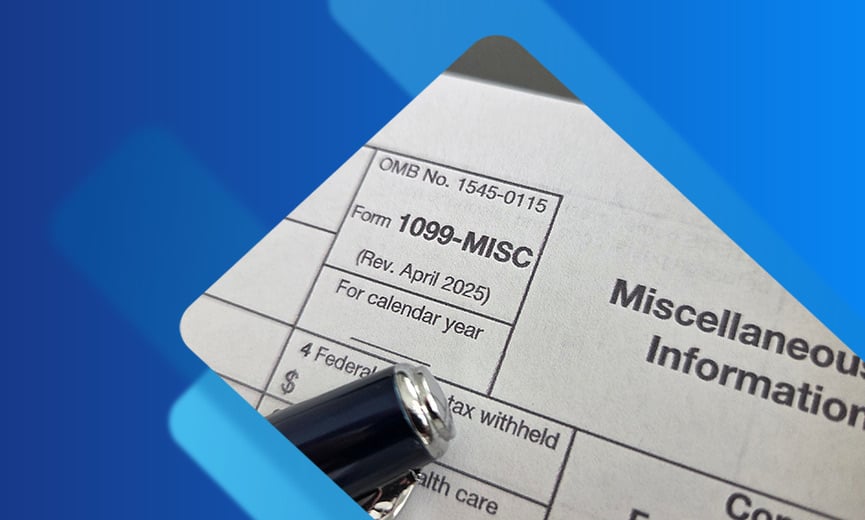
Form 1099-MISC, Miscellaneous Information, is an IRS information return that businesses use to report certain payments they make in the course of running a trade or business.
For tax year 2026, businesses generally must file Form 1099-MISC when payments to a recipient reach $2,000 for categories that include:
- Rents
- Prizes and awards that do not involve payment for services
- Medical and health care payments
- Crop insurance proceeds
- Certain payments from notional principal contracts
- Other income payments
Different thresholds apply to some categories. Businesses must report royalties of at least $10. They generally must also report at least $600 in gross proceeds to an attorney for legal services, such as settlement proceeds, in Box 10.
Other rules govern fishing boat proceeds, cash purchases of fish for resale, substitute payments in lieu of dividends or tax-exempt interest, and certain nonqualified deferred compensation.
The OBBBA also prompted changes to the December 2026 revision of Form 1099-MISC. Box 13a identifies the amount of qualifying cash tips reported in Box 3, and Box 13b identifies the applicable Treasury Tipped Occupation Code. Box 14 identifies qualifying overtime compensation reported in Box 3. These entries support the federal income tax deductions for qualified tips and qualified overtime compensation.
Form 1099-MISC generally applies to business payments, not personal expenses. A payment that has no connection to a trade or business normally does not trigger a Form 1099-MISC filing requirement.
What Form 1099-MISC No Longer Covers
Before 2020, businesses used Form 1099-MISC to report nonemployee compensation. The IRS brought back Form 1099-NEC for that purpose beginning with tax year 2020.
Today, businesses generally report payments for nonemployee services on Form 1099-NEC. Beginning in 2026, the $2,000 reporting threshold applies to those payments.
The same recipient can receive more than one type of 1099. For example, a business might pay an individual $12,000 for consulting services and another $18,000 to rent office space that the individual owns. The business generally reports the consulting fees on Form 1099-NEC and the rent on Form 1099-MISC.
The IRS also moved excess golden parachute payments for nonemployees to Form 1099-NEC beginning with tax year 2025.
For more detail on how the two forms differ, see Form 1099-NEC vs. 1099-MISC.
| Payment Type | Form to Use | 2026 Threshold |
|---|---|---|
| Rent | Form 1099-MISC, Box 1 | Generally $2,000 |
| Royalties | Form 1099-MISC, Box 2 | $10 |
| Prizes and awards not for services | Form 1099-MISC, Box 3 | Generally $2,000 |
| Medical and health care payments | Form 1099-MISC, Box 6 | Generally $2,000 |
| Gross proceeds to an attorney | Form 1099-MISC, Box 10 | $600 |
| Independent contractor fees | Form 1099-NEC, Box 1a | Generally $2,000 |
| Freelancer or consultant fees | Form 1099-NEC, Box 1a | Generally $2,000 |
| Attorney fees for services | Form 1099-NEC, Box 1a | Generally $2,000 |
| Credit card payments | Generally Form 1099-K from the payment settlement entity | Separate Form 1099-K rules apply |
| Employee wages | Form W-2 | W-2 reporting rules apply |
| Payments to C corporations or S corporations | Generally neither Form 1099-MISC nor Form 1099-NEC | Exceptions apply, including certain medical and attorney payments |
How To Tell Which Form a Payment Belongs On
The reason for the payment usually points a business toward the correct form. Compensation for services from an independent contractor, freelancer, consultant, or other nonemployee generally belongs on Form 1099-NEC.
Form 1099-MISC covers specified nonservice payments and other miscellaneous income, including rent, royalties, certain prizes and awards, medical and health care payments, and attorney gross proceeds. A business that makes different types of payments to the same recipient may need to use more than one form.
Businesses that work with independent contractors can learn more about how to pay 1099 workers and when to use a 1099 vs. W-2.
Payments That Go on Neither Form
The general corporate exemption removes many payments to C corporations and S corporations from Form 1099-MISC and Form 1099-NEC reporting. Exceptions include certain medical and health care payments and payments to attorneys.
Payment method can affect the reporting obligation as well. When a payment settlement entity reports a credit card or qualifying third-party network transaction on Form 1099-K, the business generally does not report the same transaction on Form 1099-MISC or Form 1099-NEC.
Businesses also generally do not report payments for merchandise, freight, storage, and similar items on Form 1099-MISC. Employers use Form W-2 for employee wages. See Form W-2 filing for employers for more information.
1099-MISC Filing Requirements
Whether a payment triggers a 1099-MISC filing comes down to three factors: the type of payment, the dollar amount (as thresholds vary by category), and the recipient's tax classification.
The OBBBA increased the Section 6041 reporting threshold from $600 to $2,000 for payments made after December 31, 2025. For Form 1099-MISC, the higher threshold applies to categories that include rents, prizes and awards, medical and health care payments, and crop insurance proceeds.
The threshold applies to the total paid to a recipient during the calendar year. For example, a business that makes four $600 rent payments to the same reportable recipient has paid $2,400 for the year and generally must report the payments.
Not every category moved to $2,000. Royalties remain reportable at $10 or more. The threshold for gross proceeds paid to attorneys remains $600.
The recipient's federal tax classification can also determine whether a business needs to file. Payments to C corporations and S corporations generally qualify for an exemption from Form 1099-MISC reporting, although medical and health care payments and gross proceeds paid to attorneys fall outside the general exemption.
An LLC may receive federal tax treatment as a disregarded entity, partnership, C corporation, or S corporation. Its name does not establish its tax classification. The Form W-9 provides the payee’s taxpayer identification number (TIN) and federal tax classification.
Businesses can avoid a January scramble by requesting Form W-9 from every vendor, landlord, and attorney before the first payment goes out. Collecting it early gives you time to address a missing TIN, unclear tax classification, or other incomplete information before filing season.
For additional information on business tax responsibilities, see the Employer’s Guide to Payroll Taxes.
1099-MISC Filing Deadlines and How To Submit
Businesses need to track separate deadlines for sending Form 1099-MISC to recipients and filing it with the IRS. Missing the recipient deadline can bring its own penalty, even when the IRS filing goes in on time.
Deadlines for 2026 Forms 1099-MISC:
- Recipient copies: February 1, 2027. (The general January 31 deadline falls on a Sunday.)
- Recipient copies reporting amounts in Box 8 or Box 10: February 16, 2027. (The general February 15 deadline falls on a legal holiday.)
- Paper filing with the IRS: March 1, 2027. (February 28 falls on a Sunday.)
- Electronic filing with the IRS: March 31, 2027.
Businesses that file 10 or more information returns in the aggregate generally must file electronically. The IRS counts covered information returns together for the 10-return threshold rather than applying the threshold separately to each form type.
The IRS Information Returns Intake System (IRIS) provides a free electronic filing option. The last day to submit information returns through the Filing Information Returns Electronically (FIRE) system is November 19, 2026, at 3 p.m. ET. Businesses filing tax year 2026 information returns during the 2027 filing season will use IRIS instead of FIRE. Filing directly through IRIS requires an IRIS Transmitter Control Code (TCC), and a typical application can take up to 45 business days, so businesses should apply well before filing season.
Businesses that qualify to file on paper cannot use a standard printout of Copy A from IRS.gov for the filing. The IRS requires a scannable Copy A for paper submissions. Businesses can order official forms from the IRS or use a substitute form that meets IRS printing specifications.
A year-end payroll and tax checklist can help businesses coordinate information returns with other year-end payroll and tax obligations.
Penalties for Missing 1099-MISC Deadlines
The IRS can assess separate penalties for problems with the return and the recipient statement. A business may face one penalty for failing to file a correct information return on time and another for failing to furnish a correct statement to the recipient on time.
For returns and recipient statements due in 2026, the amount generally depends on when the business corrects the failure:
Time | Cost |
|---|---|
| Within 30 days | $60 |
| More than 30 days late but by August 1 | $130 |
| After August 1 or not filed | $340 |
The IRS also imposes annual maximums. Businesses with average annual gross receipts of $5 million or less for the three most recent tax years qualify for lower annual maximums.
Intentional disregard carries a higher penalty. For information returns due in 2027, the penalty generally starts at $680 per return. For Form 1099-MISC, the IRS may instead assess 10% of the amount the business should have reported, if that figure is higher. The annual maximum does not apply to intentional-disregard penalties.
Because the penalty drops the sooner a business corrects a missed or incorrect form, fixing errors quickly is one of the most effective ways to limit the cost. The IRS may also waive penalties when a business shows the failure was due to reasonable cause and not willful neglect.
Common 1099-MISC Mistakes SMBs Make and How To Avoid Them
Many 1099-MISC problems start well before filing season. Missing vendor information, incorrect tax classifications, and poor payment records can become much harder to resolve in January.
Common mistakes include:
- Using Form 1099-MISC for contractor compensation. Businesses reported nonemployee compensation on Form 1099-MISC before 2020. Form 1099-NEC now covers compensation for nonemployee services.
- Focusing only on the IRS filing deadline. Recipient statements have their own deadlines, and late statements can result in separate penalties even when a business files with the IRS on time.
- Applying the corporate exemption too broadly. Most payments to C corporations and S corporations do not require a Form 1099, but exceptions apply to certain medical and attorney payments.
- Assuming every LLC receives the same tax treatment. An LLC may have federal tax treatment as a disregarded entity, partnership, C corporation, or S corporation. The recipient's Form W-9 provides the information needed to determine whether an exemption applies. The W-2 vs. W-9 guide provides more information about these forms.
- Waiting until January to request Form W-9. A missing taxpayer identification number can delay filing and may raise backup withholding issues. Requesting Form W-9 when the vendor relationship begins gives the business time to resolve incomplete information.
- Printing Copy A from the IRS website for paper filing. The IRS cannot process an ordinary printout of Copy A as a scannable paper return. Businesses filing on paper need an official scannable form or an approved substitute.
Form 1099-MISC FAQs
-
What Is a 1099-MISC Form Used For?
What Is a 1099-MISC Form Used For?
Businesses use Form 1099-MISC to report specific payments connected to a trade or business. Examples include rents, royalties, certain prizes and awards, medical and health care payments, crop insurance proceeds, and gross proceeds to attorneys. The reporting threshold depends on the payment type.
-
What Payments Require a 1099-MISC?
What Payments Require a 1099-MISC?
Form 1099-MISC applies to business payments that include rent, royalties, certain prizes and awards, medical and health care payments, and gross proceeds paid to attorneys. Beginning in 2026, the reporting threshold is $2,000 for many of these payments. The longstanding thresholds of $10 for royalties and $600 for attorney gross proceeds continue to apply.
-
Where Can I Get a 1099 Form?
Where Can I Get a 1099 Form?
Businesses can obtain current forms and Form 1099-MISC instructions from the IRS. IRIS and qualifying tax software provide electronic filing options.
Businesses that file paper returns should order official Form 1099-MISC copies from the IRS or use approved substitute forms. A standard printout of Copy A from IRS.gov does not meet the scanning requirements for paper filing.
-
What Happens if a Business Does Not File a 1099-MISC on Time?
What Happens if a Business Does Not File a 1099-MISC on Time?
The IRS may assess separate penalties for a late or incorrect Form 1099-MISC and a late or incorrect recipient statement. For forms due in 2027, the general penalty tiers range from $60 to $340 per return or statement, based on when the business corrects the failure. Intentional disregard carries a higher penalty that generally starts at $680 per return.
Get Your Form 1099-MISC Filing Right
In summary, the information return a business files depends on the nature of the payment. Form 1099-NEC generally covers compensation for nonemployee services, while Form 1099-MISC applies to payments such as rent, royalties, certain prizes and awards, medical and health care payments, and attorney gross proceeds.
The higher $2,000 threshold for 2026 changes the reporting requirement for many of those payments. Royalties and attorney gross proceeds continue to have their own thresholds.
Good 1099 reporting starts when a business adds a vendor, not when January arrives. A current W-9 and accurate payment records give the business the information it needs to determine which forms to file when year-end reporting begins.
Paychex offers payroll and tax services to help businesses manage payroll reporting and year-end tax responsibilities. Businesses that work with independent contractors can also explore Paychex payroll services for 1099 contractors and small business payroll services.
Tags