

Co-Employment Explained: What It Is and How It Works
- 6 min. Read
- Last Updated: 12/11/2025


Table of Contents
Managing employees, including HR issues, compliance, and payroll can pull your focus away from growing your business. A Professional Employer Organization (PEO) uses “co-employment” to help employers manage employees more effectively. In this article, we’ll break down what co-employment is, how it works, and why it matters for businesses looking to scale efficiently.
What Is Co-Employment?
Co-employment is an arrangement between a client company and a Professional Employer Organization (PEO), in which the PEO takes on certain employment-related responsibilities as outlined in a service agreement. While the client company retains operational control over employees’ day-to-day tasks, the PEO manages HR-related functions like payroll, benefits administration, and compliance with employment laws. This partnership enables businesses to focus on strategic growth while entrusting HR complexities to a specialized provider.
Co-Employment vs. Joint Employment:
Knowing what qualifies as co-employment helps companies differentiate it from joint employment and avoid compliance risks.
- In co-employment, a PEO assumes specific administrative functions, while the client company retains control over its workforce and day-to-day operations.
- Joint employment involves two or more companies, such as staffing agencies, that directly employ and share significant control over an employee's work.
Responsibilities of Each Party: Who Does What?
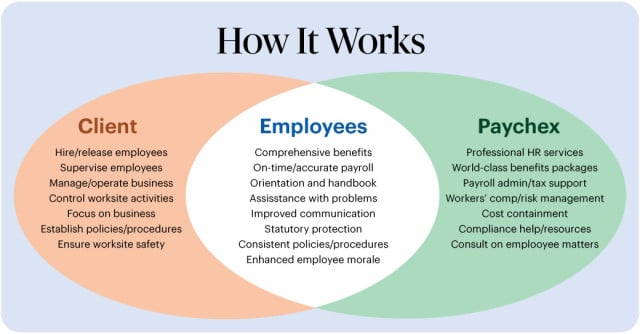
Employment-related tasks are allocated between the PEO and the client company.
The client company remains responsible for:
- Maintaining control over the work environment and operational directives
- Overseeing hiring, training, and day-to-day task management of employees
The PEO typically handles:
- Managing payroll processing, employee benefits, tax remittances, workers’ compensation, and regulatory compliance
- Providing guidance on HR policies and best practices to reduce the administrative burden on the client company
The PEO may advise on safety, culture, and training, but the ultimate responsibility lies with the client.
The Difference Between HR and a PEO
An internal HR department is part of the company and manages employee-related matters. A PEO, on the other hand, provides comprehensive HR services through a co-employment arrangement. A PEO is not meant to replace your HR team but instead act as a strategic partner.
- If your company already has an HR department, a PEO can support it by handling administrative tasks like payroll, benefits, and compliance, freeing internal HR to focus on strategic initiatives.
- If your company does not have an HR department, a PEO can serve as an outsourced HR solution, supporting business leaders, helping to ensure compliance and providing expertise without the need to build an internal team.
Benefits of Co-Employment
Partnering with a PEO offers businesses access to HR expertise, technology, and resources — freeing time for growth and helping to reduce compliance risks.
Key benefits of co-employment:
- Attract and retain top talent
- Free up time to focus on company goals
- Reduce exposure to compliance-related risks
- Flexibility of services as your workforce grows or changes
- Improve productivity with access to advanced HR technology and guidance
By taking advantage of these benefits, businesses may improve efficiency, reduce costs, and gain a competitive edge in their industry.
Why Consider a PEO and Co-Employment for Growing Businesses
As your business scales, HR complexity grows. Partnering with a PEO through co-employment can provide access to a wide range of HR services, expertise, and technology that may otherwise be too costly or difficult to develop in-house.
Key reasons to consider a PEO and co-employment:
- Cost-Effectiveness: Sharing responsibilities can reduce HR administration costs, allowing businesses to allocate resources more strategically.
- Expertise and Compliance: PEOs bring specialized knowledge in complex areas such as labor laws and compliance, significantly mitigating the risk of legal issues.
- Employee Benefits: Access to quality employee benefits packages that might be otherwise unattainable for smaller companies.
- Focus on Core Business: By freeing up valuable resources utilizing a trusted provider, companies can concentrate on strategic growth and operational efficiency.
To determine if a PEO co-employment arrangement is right for your growing business, evaluate your current HR needs considering workforce size, industry-specific requirements, and long-term growth plans. Compare these needs to the benefits and risks of co-employment to make an informed decision about whether a PEO partnership is the best strategy for supporting your business's growth and success.

Streamline Your HR With Paychex PEO
Paychex PEO helps businesses efficiently manage HR, allowing them to focus on core competencies. Discover how our PEO can help your business thrive.
Tags