

Most Employees Catch Paycheck Errors Themselves. Here’s How To Get Ahead of Them
- 6 min. Read
- Last Updated: 11/06/2026

Table of Contents
A payroll mistake can look small on your end, but for employees it can mean overdraft fees or missed bills. Paychex’s recent Employee Compensation Confidence Index, an anonymous, public survey of 1,034 full-time U.S. employees about their pay conducted online by independent research firm Centiment, found that 42% of those who had a paycheck error in the past year paid out of pocket for it in overdraft or late fees. For some, those costs meant delaying necessities like groceries, gas, or medicine.
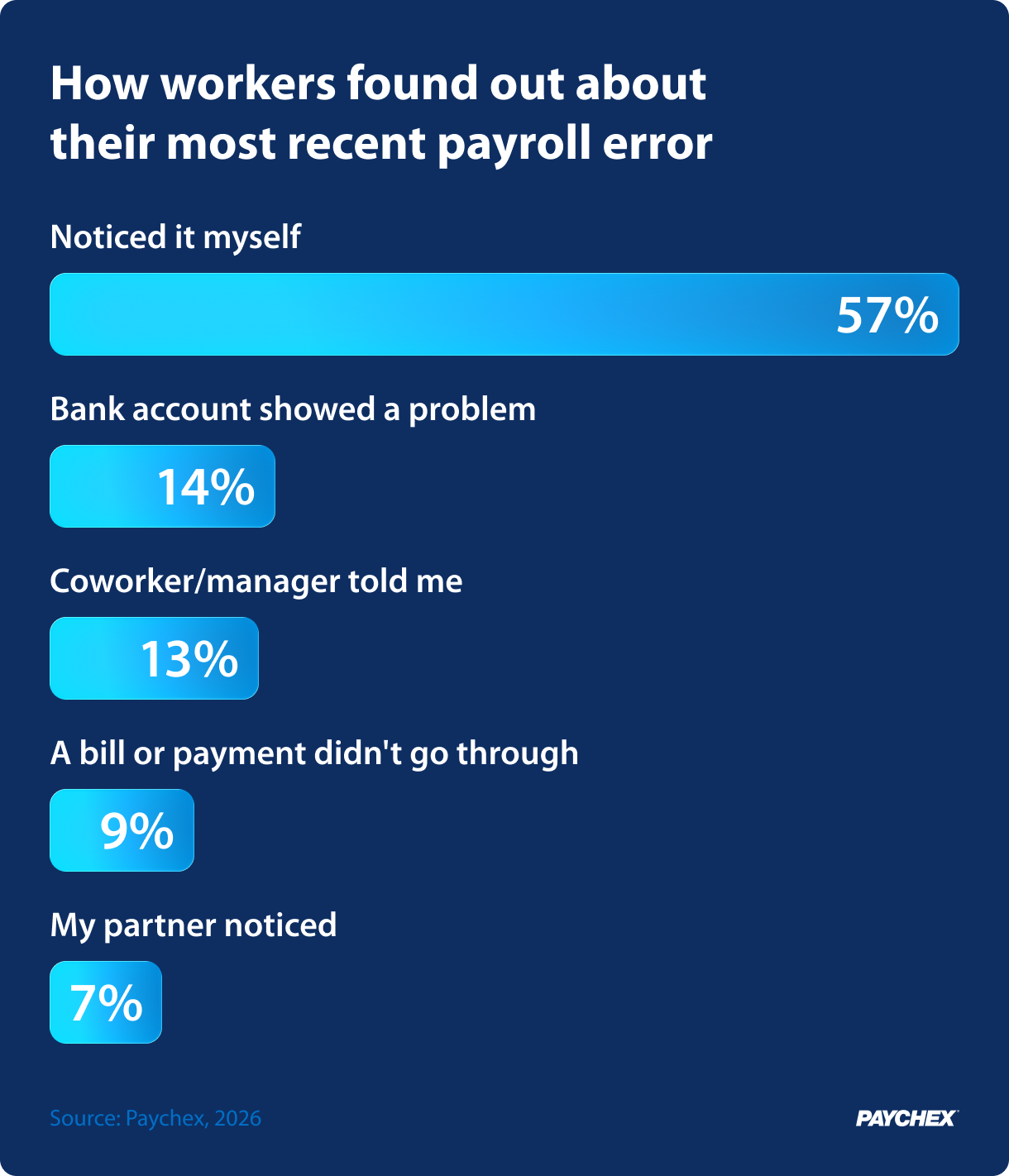
And employers often aren’t the first to know when something goes wrong. Of the 43% of employees who had a paycheck error in the past year, 57% caught their most recent one themselves. Only 13% heard about it from a coworker or manager.
The good news is that most employees trust that their pay is right: 96% are at least somewhat confident their paycheck is calculated correctly every pay period. But each error chips away at that trust, and nearly half of employees (47%) say a problem with their pay has made them seriously consider leaving a job. Here’s how to catch payroll mistakes before payday, make them easy for employees to report, and fix them quickly when they slip through.
How To Catch Payroll Errors Before Payday
The simplest way to avoid making payroll errors is to catch them before employees ever see them. Before you approve each payroll, check the figures that will appear on employees’ paystubs against your own records:
- Earnings: Confirm that hours match approved timesheets and that overtime is calculated for eligible employees under applicable federal and state law. Make sure pay rates reflect any recent raises or role changes.
- Deductions and Reimbursements: Check that deductions match each employee’s current benefit elections.
- Pretax Deductions, like health insurance premiums and traditional 401(k) contributions, should reflect any changes from open enrollment or a qualifying life event.
- Post-tax Deductions, like Roth 401(k) contributions, wage garnishments, and union dues, should match the latest election or court order.
- Reimbursements, like expense reimbursements or stipends for remote work or phone use, should go to the right employees and stay separate from wages.
- Taxes: Confirm federal income tax, Social Security, Medicare, and any state and local taxes are withheld correctly, especially for employees who moved or work in more than one state.
- Net Pay: Flag amounts that are unusually high or low compared to the last pay period. A big swing is often the first sign of an error.
- Withholding Elections: Make sure payroll is using each employee’s most recent Form W-4 (and state withholding form, if applicable).
- PTO and Sick Time Information: Check that accrued, used, and remaining balances reflect approved time off.
- Year-to-date Amounts: Watch for employees nearing the Social Security wage base or 401(k) contribution limits, which change how much is withheld.
- Direct Deposit Details: Verify any new or changed bank account information before payroll runs. A mistyped account number can delay pay entirely.
It also helps to give employees a chance to check their own pay before it lands. In Paychex’s survey, the most common thing employees said would increase their trust in their paychecks was access to a preview of their check (48%). About a quarter (24%) said a plain-language breakdown of their pay would help. A short guide to reading the paystub can do the same.
Beyond each payroll run, audit deductions, withholding, and pay rates at least twice a year, and after open enrollment or a round of raises. Employees don’t always catch errors right away: 22% of workers who had a paycheck mistake didn’t find out about their most recent mistake until their bank account flagged a problem or a bill didn’t go through.
The Most Common Payroll Errors, and Where They Start
Payroll errors can be as simple as a mistyped bank account number, but across their working lives, workers most often report being either paid late (28%) or paid for the incorrect number of hours (27%), according to Paychex’s survey.
Here’s where common errors tend to start:
- Late or Missed Pay: Missed processing deadlines, bank holidays, and late direct deposit changes can delay pay or keep it from arriving at all. In fact, 11% of workers have had a missed paycheck at some point.
- Misclassifying Workers: Treating an employee as an independent contractor, or classifying a nonexempt employee as exempt, can lead to incorrect tax withholding and unpaid overtime.
- Time and Hour Tracking: Manual timesheets, missed punches, and unapproved edits can lead to paying hourly employees for the wrong number of hours or miscalculating overtime.
- Tax Errors: An employee may fill out Form W-4 incorrectly, or payroll may not apply the most recent version. Wrong tax withholding has affected 16% of workers.
- Wrong Deductions: Benefit changes that don’t make it into payroll can lead to withholding the wrong amount for health insurance, retirement contributions, or garnishments. Wrong deductions have affected 18% of workers.
- Outdated Information: Raises, promotions, and name changes don’t always reach payroll right away. That lag can lead to a wrong pay rate, which 16% of workers have experienced.
Many of these start with a simple human error, so keep a consistent paper trail. The Fair Labor Standards Act (FLSA) requires employers to keep general payroll records for at least three years and timecards for at least two. Many employers keep payroll records for four to seven years to account for IRS employment tax recordkeeping rules (at least four years), state wage laws, and potential wage claims. Good records also make it faster to confirm and fix a mistake.
What To Do When an Employee Reports a Payroll Error
Since employees are usually the first to spot a payroll mistake, make sure they know who to tell. Ask them to report errors in writing to HR or payroll, with the pay date, what looks wrong, and what they believe the correct amount is. Then confirm you received the report and give a timeline for the fix.
When an error shortchanges an employee, correct it quickly, often with an off-cycle payment rather than waiting for the next payday, and confirm the fix in writing. If the mistake caused overdraft or late fees, consider covering those, too. A note like this can do both:
“We found an error in your [date] paycheck: [what went wrong]. We’ve issued a corrected payment of [amount], which should arrive by [date]. If the error caused any bank or late fees, send us the details and we’ll reimburse them.”
Federal law generally doesn’t require employers to reimburse bank fees caused by payroll errors, but offering to goes a long way toward preserving trust.
Some payroll errors do carry legal obligations, though. If an error amounts to a wage violation under a wage payment law, you may owe employees back pay.
The FLSA sets the federal wage standards that most private and government employers must follow, including rules about minimum wage, overtime, tips, and hours worked. Two of its most notable rules are:
- Covered nonexempt workers are entitled to a minimum wage of at least $7.25 per hour. If their state or local minimum wage is higher, they’re entitled to that instead.
- Covered nonexempt workers must receive overtime pay of at least 1.5 times their regular rate of pay for hours worked over 40 in a workweek. Some states have stricter overtime rules, such as daily overtime thresholds, so check what applies where your employees work.
If a payroll error drops an employee’s pay below minimum wage or shorts their overtime, it may be a federal wage violation. Many other errors, like late pay or wrong deductions, are governed by state law.
The FLSA sets a federal floor, but state rules on pay timing, deductions, and penalties for late or short pay vary. Check your state’s labor office for the rules that apply to your business. Employees who believe they’ve been underpaid can also file a free, confidential complaint with the U.S. Department of Labor’s Wage and Hour Division. If you’re unsure whether an error creates legal exposure, talk to an employment attorney.
Payroll Mistakes Happen, but How You Handle Them Builds Trust
Most companies already work to reduce errors, and employees understand that mistakes happen. What they count on is a quick fix: 91% of employees are at least somewhat confident a paycheck error would be fixed quickly once they flag it. Check payroll before it runs, make errors easy to report, and fix them fast, and you’ll keep that confidence intact.
Methodology
The survey was conducted online by Centiment for Paychex, with a total sample size of 1,034 full-time employed U.S. adults aged 18 and older. To qualify, each respondent had to be currently employed by an employer (not self-employed or a business owner) and receive a regular paycheck. Fieldwork was undertaken from August 21 to August 31, 2026. Results are weighted to match the U.S. census. The margin of error is approximately ±3% for the overall sample at a 95% confidence level.

Tags